Compelling Case for a Children’s Budget
Reflections on latest Poverty, Income Inequality and Living Standards Research
By Denise Charlton (article first appeared in The Irish Examiner 8th Sept 2026)
Inequality is embedded in our communities. The stark reality that economic growth alone does not guarantee social progress – or opportunities for all children – has been laid bare in latest (8th Sept 2026) Poverty, Income Inequality and Living Standards findings by the Economic and Social Research Institute.
Families Left Behind
Even in times of recovery and prosperity, when overall average household incomes rise, many families remain left behind in particular those with young children. To put it bluntly in our country today, a rising tide does not lift all boats
Of course, we must also set the findings in the context of the now pro-longed cost-of-living crisis which anyone whose household chores includes doing the regular trips to the grocery shop will know shows little sign of abating.
Now it’s sixth year this research produced in partnership with Community Foundation Ireland puts statistics and hard facts behind the voices of deep concern we are also hearing from voluntary, community and charitable groups on the ground are correct, and must not be ignored.
The findings add punch in the glove for many of those groups actively involved in advocacy and campaigning during the current End Child Poverty Week, organised and led by the Children’s Rights Alliance. They are unified and speak as one in demanding that Budget 2027 is a children’s budget.
The Compelling Argument
The research experts, the advocates and those in the frontline in addressing poverty all agree, children living in sustained deprivation today face greater risks in relation to educational attainment, health, wellbeing and future employment prospects.
The consequences are far-reaching, impacting not only individual life chances but also the social and economic wellbeing of society.
Poverty must not be viewed as an immediate need which can be addressed with some quick fix, but as a long-term social and economic challenge with consequences that can stretch from childhood into adulthood. Viewed through that prism, the arguments for strategic action are not merely persuasive, they are compelling.
The case for reforming child benefit has not diminished. If anything, the findings of this report make it stronger. Additional supports are needed for many households, including lone-parent households, larger families, migrant families, and households experiencing unemployment or lower levels of educational attainment.
A Way Forward
Participating in End Child Poverty Week activities I have had the opportunity to listen to children, parents, teachers and community leaders. Each have very similar views on how we can break this inter-generational spiral of inequality. Views shared in the policy now options advanced by the ESRI.
Children always bring the greatest clarity, refreshingly they do not couch their views in bureaucratic jargon but great straight to the point. Access to playgrounds, green areas, sport and play and more opportunities is what they want – and they want it for every child, no exceptions.
Views which echo the calls for true investment in communities and local facilities which we hear at the community foundation from groups in every part of our country, urban and rural, older communities and those which are new.
Progress achieved in recent years through the roll out of Deis+ Schools with extra supports and resources must not only continue but must be stepped up. The provision of hot school meals must be further expanded from pilot schemes addressing holiday hunger to ensure no child misses meals during mid-terms and longer school breaks.
The evidence that one-in-five children living in poverty once housing costs are taken into account is the primary case for a proper children’s budget – with proper targeting so those families who need the most support receive it.
Time for Ambition
It would be wrong and unfair to say Government has not responded to our series reports which have been presented or to the advocacy of groups working with children. There have been positive developments, and they should be acknowledged. The aforementioned school meals, extra resources and increased in universal benefits for children have been helpful.
What has proven elusive for policymakers has been the ambition, courage and leadership required to deliver true systemic change – the sort of change only made possible by big reforms such as targeted child benefit.
Earlier in the series of reports there was a finding that we are in danger of becoming the first generation in modern Ireland to pass on a poorer society to the next.
Unless proper, strategic steps are taken now which finally move the dial on poverty and deprivation levels we can add growing inequality and a widening income gap to what would be a shameful legacy.
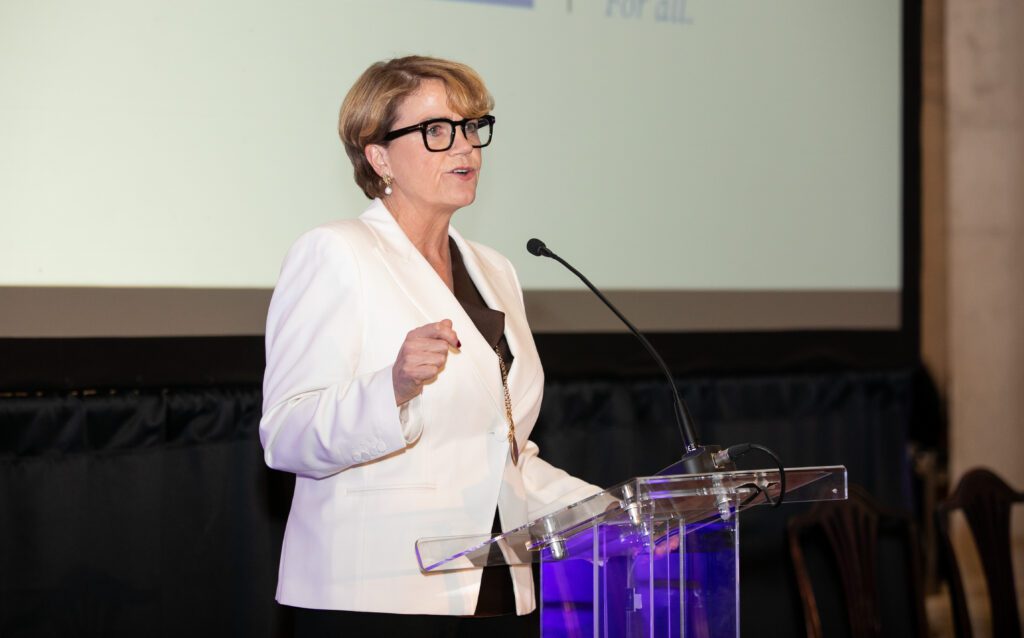
Denise Charlton is Chief Executive of Community Foundation Ireland which mobilises strategic philanthropy to advance equality, strengthen communities and protect climate and nature.
Community Foundation Ireland
Community Foundation Ireland mobilises strategic philanthropy to advance equality, strengthen communities and protect climate and nature. A philanthropic hub our priority pillars are people, place and planet. People helps ensure everyone can live with dignity, feel part of their community and wider society. Place means working with partners to support communities where everyone participates. Planet is our response to the crisis in climate and nature at every level. The Foundation was established in 2000.